
Antonij (‘Anton’) Mauve
Dutch, Zaandam 1838 – 1888 Arnhem
Anton Mauve was born in Zaandam in 1838. At the age of 5, his family moved to the city of Haarlem, were his father had been appointed as the new pastor. As Haarlem did not have a prestigious art school in the 1850s, Mauve became an apprentice of cattle-painter Pieter Frederik van Os and subsequently of famous horse painter Wouterus Verschuur. Together with his friend and colleague Constant Gabriel, he frequently went outdoors to paint. Gabriël also introduced Mauve to the painters community in the rural village of Oosterbeek, where Mauve discovered impressionist painting.
In 1871 the artist moved to The Hague, then the epicenter of contemporary (impressionist) art in The Netherlands. Mauve hired a studio and focused on painting landscapes with cattle like plow horses on the field, sheepfolds or woodcutters in typical greyish and brownish tones. Moreover, he also painted beach scenes with drought-horses, shell gatherers or donkeys at nearby Scheveningen Beach. Eventually Mauve became one the most famous artist of the Dutch Hague School.
Besides oil painting Mauve also flourished in watercolour painting. As a matter of fact, Mauve was also one of the finest watercolourists of his time. Has had many students, among who famous cousin Vincent van Gogh . (Actually, Van Gogh was his wife’s cousin). It was in 1882, when Mauve already had built a respectable reputation as an artist, that Van Gogh became his apprentice. Van Gogh greatly admired Mauve’s work and wanted to study his watercolouring techniques. Mauve introduced his cousin Van Gogh with other great Hague School artist like the brothers Maris, J.H. Weissenbruch, Hendrik Willem Mesdag, George Breitner and Jozef Israëls. Despite his effort, Van Gogh left Mauve’s studio only after a couple of weeks because Mauve couldn’t handle his cousins temper.
Since the summer of 1882 Mauve often worked in the rural village of Laren, were also a large and vibrant art community had been established. In 1885 he even bought a house there. By then Mauve sold his pictures, not only within the Netherlands but also abroad. Many of his collectors lived in the United Kingdom, the United States and Canada. In 1887 Mauve won the gold medal on the famous Paris Salon for his oil painting Return of the flock.
Despite his arguments with Mauve, Van Gogh maintained his affection for the artwork of his cousin. He once wrote about Mauve in one of his letters: “I believe he [Mauve] puts a little piece of his life to every painting or drawing”. Also, Mauve’s artistic influence on Van Gogh appeared to be much greater than previously assumed. Subjects as diggers, potato-eaters and wood sellers actually all came from Anton Mauve.
Mauve died of an aneurysm in 1888, 6 years after Van Gogh left his studio and moved to France. Van Gogh was greatly affected by his death. As a tribute to his short-term master he created a beautiful painting of a peach tree which he named “Souvenir de Mauve”.
Works in museum collections
Rijksmuseum (Amsterdam), Singer (Laren), Kunstmuseum (Den Haag), Museum Boijmans van Beuningen (Rotterdam), Centraal Museum (Utrecht), Kroller-Muller Museum (Otterlo), De Mesdag Collectie (Den Haag), Van Gogh Museum (Amsterdam), Stedelijk Museum (Amsterdam), Rijksmuseum Twenthe (Enschede), Museo Nacional Thyssen Bornemisza (Madrid), Metropolitan Museum of Art (New York), Teylers Museum (Haarlem), National Gallery of Scotland (Edinburgh), Toledo Museum of Art, Sheffield City Art Galleries, Leeds Museums and Art Galleries, Boston Museum of Fine Arts, Ashmolean Museum at the University of Oxford, York City Art Gallery, The Burrell Collection (Glasgow). Philadelphia Museum of Art, Musée d’Orsay (Paris), National Gallery (London), National Gallery of Art (Washington), Tate Gallery (London), Allen Art Museum at Oberlin College (Ohio), National Museum Wales (Cardiff), Art Gallery of New South Wales (Sydney), Block Museum of Art at Northwestern University (Illinoi), Bowdoin College Museum of Art (Maine), Brooklyn Museum (New York), Cleveland Museum of Art, Courtauld Institute of Art (London), Dordrechts Museum, Dublin City Gallery, Frick Collection (New York), Harvard University Art Museums, Lakeview Museum of Arts and Sciences (Peoria, Illinois), Lauren Rogers Museum of Art, (Laurel, Mississippi), MacKenzie Art Gallery (Saskatchewan), McMullen Museum of Art at Boston College, Memorial Art Gallery of the University of Rochester, Mildred Lane Kemper Art Museum (St. Louis, Missouri), The Walters Art Museum (Maryland), Winnipeg Art Gallery (Manitoba)
Paintings by Anton Mauve in the collection of Kunsthandel Bies:
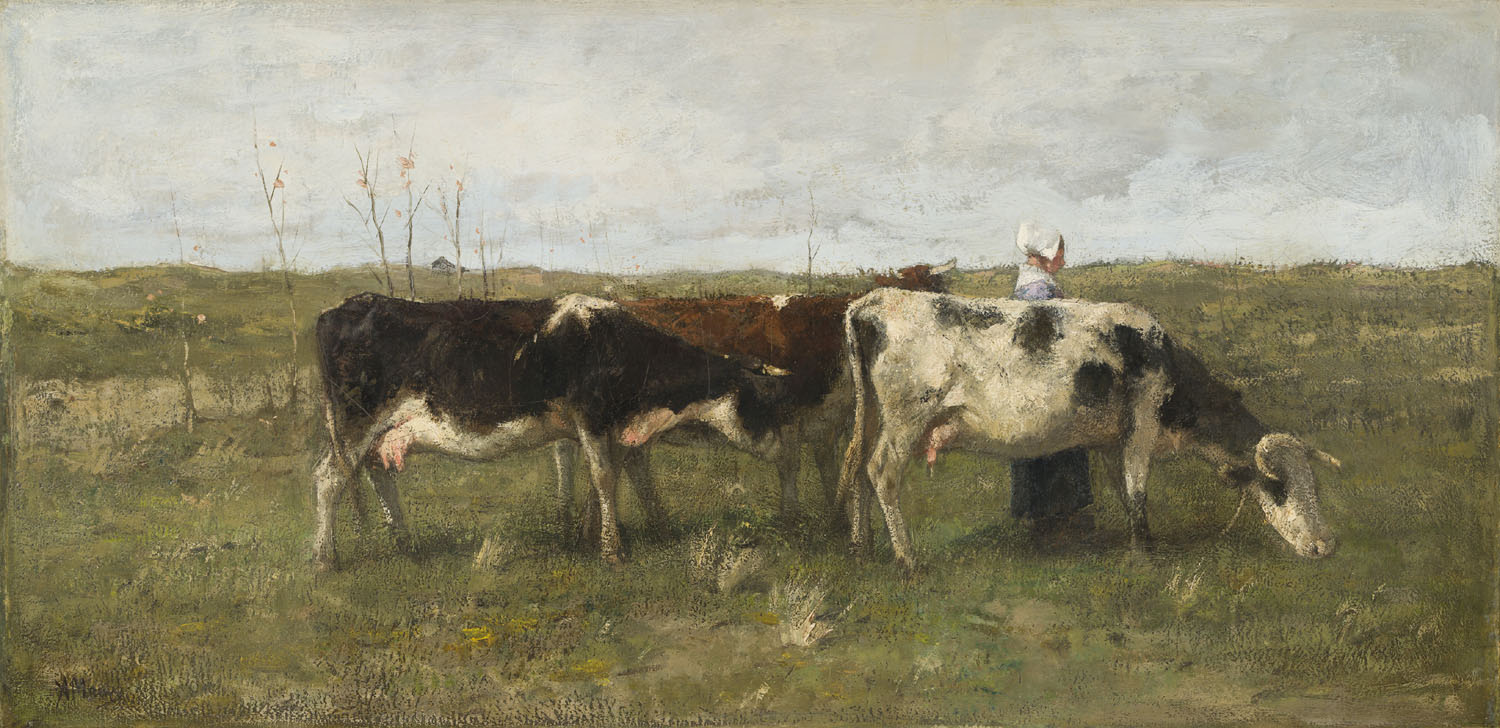
Homeward bound
